A trial balance is a report that lists all ledger account balances to check that total debits equal total credits.
What is a Trial Balance?
A trial balance is a report that lists all the balances from the general ledger accounts at a specific date. It is used to check whether total debits equal total credits, ensuring the double‑entry system has been applied correctly.
If the trial balance doesn’t balance, it signals errors such as incorrect postings, missing entries, or transposed numbers.
Purpose of a Trial Balance
- Error Detection: Ensures debits and credits match.
- Preparation for Financial Statements: Serves as the basis for the income statement and balance sheet.
- Organization: Summarizes all ledger balances in one place.
- Audit Trail: Provides evidence of proper bookkeeping.
Steps to Prepare a Trial Balance
- Close the Journals: Ensure all transactions for the period are recorded in the journals.
- Post to the Ledger: Transfer each journal entry into the appropriate ledger accounts.
- Calculate Ledger Balances: Add up debits and credits in each account to find the ending balance.
- List Accounts: Write down all accounts from the chart of accounts with their balances.
- Separate Debits and Credits: Place debit balances in the debit column and credit balances in the credit column.
- Add Totals: Sum both columns.
- Check Equality: If totals match, the trial balance is correct. If not, investigate errors such as missing entries, incorrect postings, or transposed numbers.
- Prepare for Financial Statements: Once balanced, use the trial balance as the starting point for the income statement and balance sheet.
Example
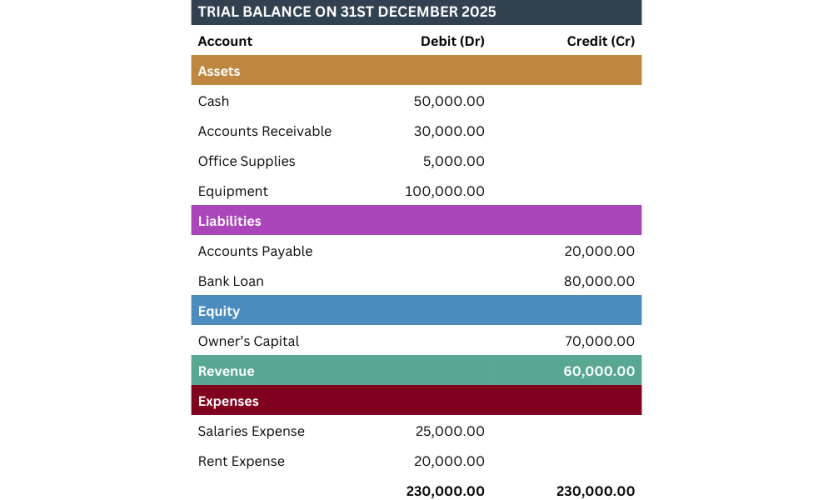
Summary
A trial balance is a vital checkpoint in the accounting cycle, ensuring that total debits equal total credits before financial statements are prepared. By summarizing ledger balances into one report, it helps detect errors, supports compliance, and provides the foundation for accurate reporting. With clear steps recording transactions, posting to ledgers, calculating balances, and verifying totals the trial balance strengthens transparency and reliability in a business’s financial records.