The income statement is your performance report—it shows whether your business made a profit or a loss during a specific period.
What Is an Income Statement?
An income statement is one of the three core financial statements, alongside the balance sheet and cash flow statement. Unlike the balance sheet, which is a snapshot at a single point in time, the income statement covers a period (such as a month, quarter, or year) and shows how the business performed financially during that time.
It answers the key question: Did the business generate a profit or a loss during this period? To do so, it reports revenues, expenses, gains, and losses, ultimately arriving at net income (or net loss).
The income statement is crucial for investors, managers, and creditors, as it highlights whether the business model is sustainable, how efficiently resources are being used, and whether the company is creating value.
Together with the other financial statements, it provides a complete picture of the financial health of the business.
Components of an Income Statement
Revenues (Sales/Income)
- Money earned from selling goods or services.
May include operating revenue (main business activities) and non‑operating revenue (interest, investments).
Expenses
- Operating expenses: Salaries, rent, utilities, depreciation.
- Cost of Goods Sold (COGS): Direct costs of producing goods sold.
Non‑operating expenses: Interest expense, taxes.
Gains and Losses
- Gains: Profit from selling an asset above its book value.
Losses: Costs from selling an asset below its book value or unusual events.
Net Income (Profit or Loss)
- The “bottom line.”
- Positive (+) = profit; negative (-) = loss.
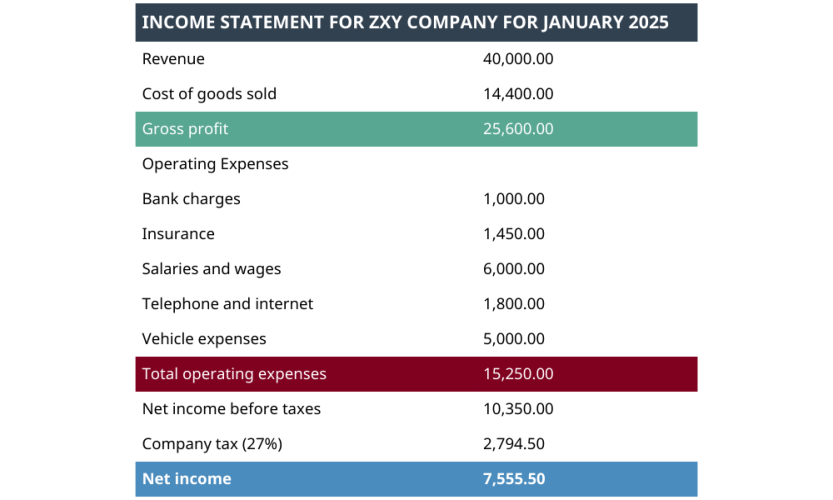
Example
Why Income Statements Matter
Income statements are important because they provide a performance check, showing a company’s profitability over time. They guide decision‑making by helping managers adjust pricing, control costs, and refine strategy. For investors, income statements reveal whether the business is profitable and sustainable, offering insight into long‑term viability. They are also essential for compliance, as they are required for audits, tax filings, and formal financial reporting. Finally, by comparing income statements across multiple periods, businesses can analyze trends, track growth, or identify signs of decline.
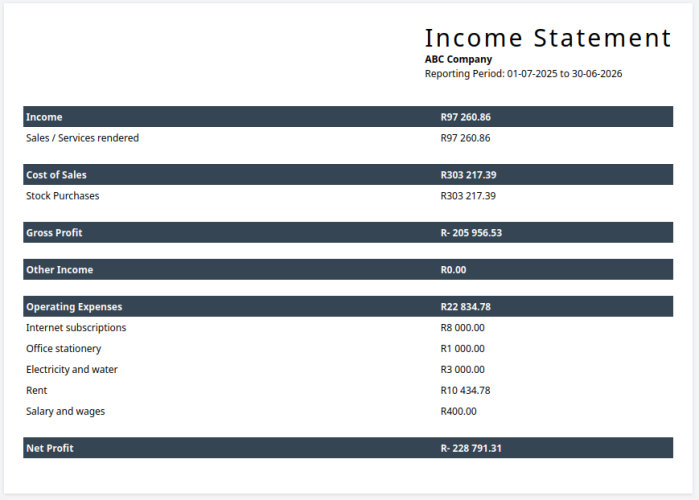
Income Statements on payPod
Below is an income statement generated automatically by the system on payPod.
Summary
- Income Statement = revenues, expenses, and net profit/loss over a period.
- Formula: Net Income = Revenue – Expenses.
- Divided into revenues, expenses, gains/losses, and net income.
- Essential for profitability analysis, decision‑making, and compliance.