A balance sheet is your business’s financial snapshot—showing what you own, what you owe, and the value left for the owner, all neatly balanced by the accounting equation.
What is a Balance Sheet ?
A balance sheet is a structured report that summarizes a company’s financial standing. Unlike the income statement, which covers a period of time, the balance sheet is a snapshot taken on a particular date (e.g., year‑end or month‑end).
It follows the fundamental accounting equation.

This equation must always balance or the balance sheet is meaningless.
Components of a Balance Sheet
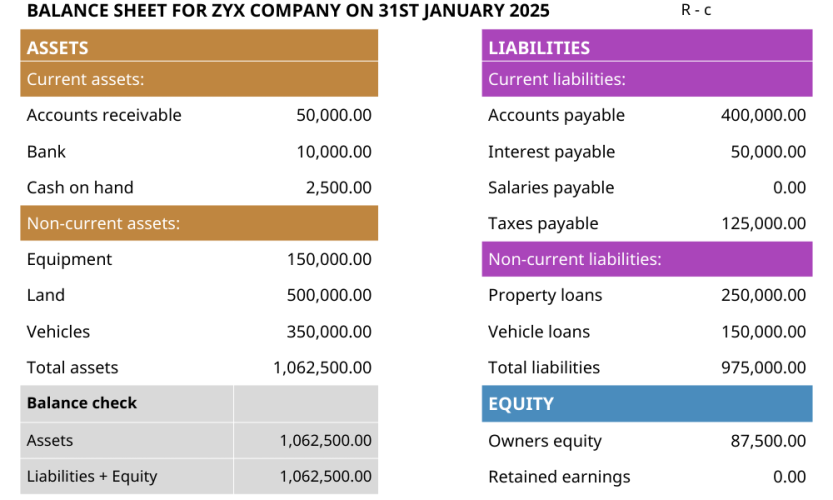
Assets are resources owned by the business that have economic value. They are divided into:
- Current assets: Cash, accounts receivable, inventory. Assets expected to be used or converted into cash within 12 months.
- Non‑current assets: Property, equipment, long‑term investments — provide value over several years.
Liabilities are obligations the business owes to outsiders. They are divided into:
- Current liabilities: Accounts payable, short‑term loans, accrued expenses — due within 12 months.
- Non‑current liabilities: Long‑term debt, lease obligations — due after more than a year.
Equity represents the owners’ residual interest after liabilities are subtracted from assets. It includes:
- Share capital (money invested by owners/shareholders)
- Retained earnings (profits reinvested into the business)
Example
Why Balance Sheets Matter
Balance sheets are important because they provide a clear picture of a company’s financial health, showing both solvency and liquidity. They help managers, investors, and lenders make better decisions by assessing risk and stability. A balance sheet also supports cash flow planning, since it reveals whether short‑term assets are enough to cover short‑term liabilities.
In addition, balance sheets are required for audits, tax filings, and regulatory reporting and ensuring compliance. Finally, comparing balance sheets over time allows businesses to track growth, changes in debt, and the buildup of equity, giving valuable insight into long‑term performance.
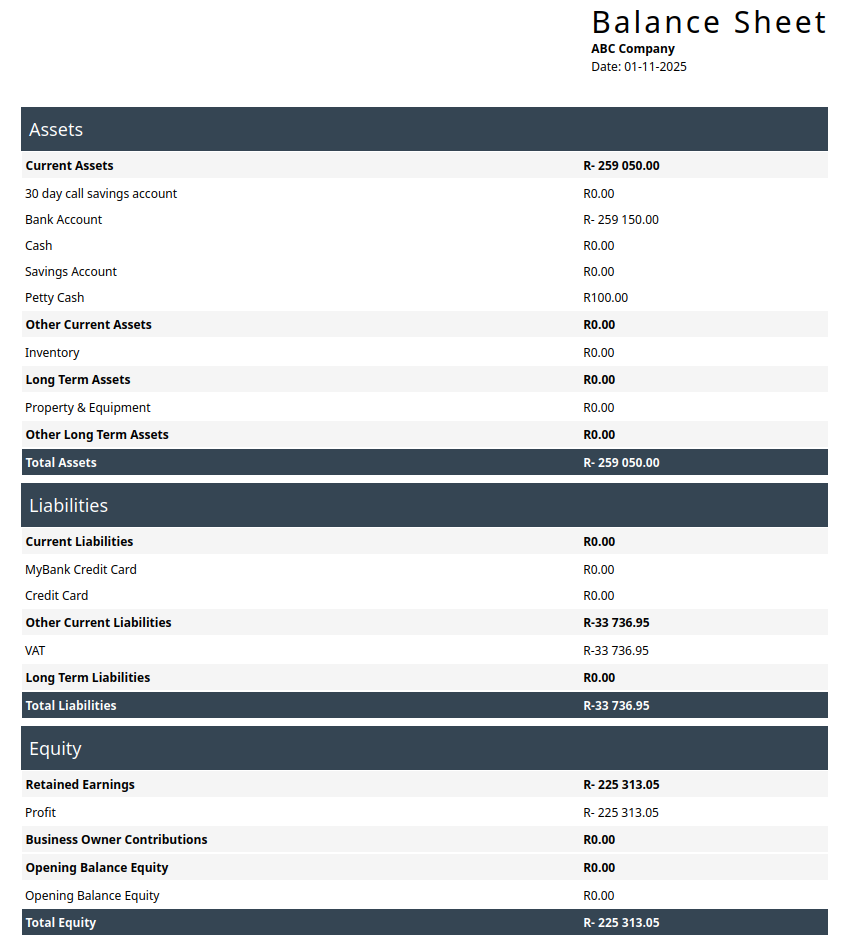
Balance Sheets on payPod
Below is a balance sheet generated automatically by the system on payPod.
Summary
- A balance sheet = snapshot of assets, liabilities, and equity at a point in time.
- Assets must equal liabilities + equity (accounting equation).
- Divided into current vs non‑current categories for both assets and liabilities.
- Essential for cash flow management, investment decisions, and compliance.